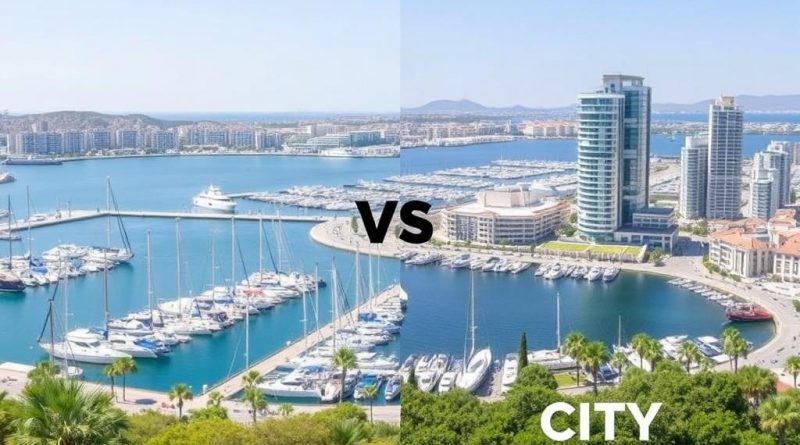
Limassol Marina vs City Center: Investment Property Comparison
The choice between waterfront prestige and urban core convenience shapes the investment profile for many buyers in Limassol. Whether you are assessing long-term capital appreciation, short-term rental income, or lifestyle alignment, the trade-offs are concrete and measurable. For a quick entry point to available inventory and market listings, explore real estate Limassol to calibrate expectations against live offers.
This article provides a technical and narrative analysis of two distinct markets within the same city: Limassol Marina property and Limassol city center real estate. It frames supply and demand drivers, physical and regulatory constraints, investor profiles, financing and tax impacts, on-the-ground management considerations, and a pragmatic decision framework for choosing between the two. Readers will find data-oriented comparisons, operational checklists, and realistic scenarios to help with a purchase decision.
Market fundamentals and macro context
Limassol sits at the intersection of geopolitical stability, Mediterranean tourism flows, and a resilient service economy. That macro picture influences both waterfront projects and central urban stock but in different ways. The marina enclave is shaped by high-end tourism demand, international buyer interest, and limited buildable land. The city center benefits from a wider buyer base, ongoing urban regeneration, and diverse commercial tenants.
Assessing the fundamentals requires separating demand drivers: luxury lifestyle buyers and international second-home owners dominate Limassol Marina property transactions, while local professionals, young families, and investors seeking steady rental yield are the primary consumers of Limassol city center real estate. Supply-side constraints differ: marina parcels are finite and often delivered as branded developments; city center supply is a mix of older stock undergoing renovation and new mid-rise blocks.
Understand the macro drivers first—limited waterfront supply supports premium pricing; wider urban supply supports volume and flexibility.
Interest-rate sensitivity and currency dynamics should be considered. Global capital flow volatility affects prime waterfront assets more strongly, while urban assets show higher local market insulation. For an investor comparing the two, the weighting of foreign vs domestic demand in the buyer pool influences price elasticity and rental dynamics.
Finally, consider demand seasonality. Marina properties capture high-season short-term rentals and seasonal lifestyle demand; city center properties tend to generate more consistent, year-round tenancy from professionals and long-term renters.
Physical and urban differences that determine value
Built form, accessibility, and immediate amenities are structural determinants of capital value and operating performance. Limassol Marina property sits along a human-designed waterfront with marina berths, promenades, and a cluster of hospitality and leisure uses. The city center is an organically evolved grid with offices, retail arteries, municipal services, and dense residential blocks. These differences translate into divergent cash-flow and appreciation profiles.
Waterfront projects typically offer larger floor-to-ceiling heights, superior finishes, and private amenities—concierge, gym, pools, marina access—that command premium pricing. Urban core units may be smaller per unit but offer higher unit density and a larger absorption pool. When evaluating properties, adjust comparable metrics to reflect unit mix, amenity sets, and effective service charges rather than headline asking prices alone.
Built form and amenities create price multipliers—compare apples to apples by adjusting for usable area, parking, and service package.
Accessibility also matters. The city center benefits from multi-modal transport links, proximity to offices and schools, and a broader retail catchment; many buyers prize those daily conveniences. Conversely, the marina appeals to leisure mobility—boating, waterfront dining, and resort-style living—so purchasing motivations are often lifestyle-led rather than commute-driven.
Environmental exposures differ. Marina properties face greater seawater corrosion, flood risk considerations, and stricter coastal building codes. These factors drive higher long-term maintenance budgets and insurance premiums. City center assets are more exposed to urban nuisances—noise, tight parking, and older building systems—but maintenance is often more predictable and incremental.
Architecture, finishes, and service models at the Marina
Limassol Marina developments are typically conceived as integrated lifestyle compounds. Developers optimize views, orientation, and public spaces to create scarcity value. Architectural programmes emphasize luxury finishes, high-spec MEP (mechanical, electrical, plumbing) systems, and hospitality-grade service models that can include on-site management companies and branded leasing channels.
For investors, that translates into higher entry prices and higher variable operating expenses. Service charges and sinking funds must be scrutinized because they materially affect net yields. Ensure due diligence includes historical service charge schedules and comprehensive lifecycle maintenance forecasts for façade, mechanical plant, and marina infrastructure.
Building stock, retrofits, and urban dynamics in the city center
Limassol city center real estate spans older masonry buildings, mid-20th-century apartment blocks, and newer infill developments. The variability creates arbitrage opportunities through targeted renovations and repositioning. Urban regeneration initiatives—public realm upgrades, new cultural facilities, or transport improvements—can uplift adjacent values, but they also introduce timing risk.
Investors who are operationally capable—those who can deliver renovations cost-effectively and manage tenant transitions—can capture higher returns in the city center. This segment is fertile for small-batch value-add plays, whereas the Marina is more suitable for hands-off, capital appreciation strategies tied to macro demand for luxury waterfront living.
Comparative metrics: prices, yields, liquidity, and operating costs
To make rational comparisons, normalize financial metrics per square meter and per unit where possible. Use gross and net yield calculations, factoring in realistic vacancy assumptions and service charge regimes. Below is a concise table outlining key comparative metrics that typically influence investor decisions. These figures are illustrative ranges based on recent market surveys and should be validated with local data at the time of purchase.
| Metric | Limassol Marina property (typical) | Limassol city center real estate (typical) |
|---|---|---|
| Price per m² (market range) | High — premium 15–40% above city core | Mid — broader range, more sub-€ per m² tiers |
| Gross rental yield (long-term) | Lower — often 2–4% due to high entry | Higher — often 4–7% depending on segment |
| Short-term rental yield (seasonal) | High during season — premium nightly rates | Moderate — steady occupancy, lower nightly rates |
| Average vacancy risk | Higher off-season for leisure units | Lower — steady demand from local renters |
| Maintenance & service charges | High — marina infrastructure and finishes | Variable — lower for standard blocks, higher for renovated luxury products |
| Exit liquidity | Strong for premium buyers, narrower market | Broader buyer pool, generally higher liquidity |
Marina prices buy lifestyle and scarcity; city center buys liquidity and operational flexibility.
Interpreting the table requires an investor’s time horizon. A short to medium-term investor focused on cash flow will typically prefer city-center assets. A long-term investor seeking capital appreciation and brand exposure may orient toward marina units. However, the marina’s premium can be justified where foreign buyer demand, project branding, and restrictive supply combine to produce sustained price growth.
When you model returns, include renovation costs, fit-out budgets for short-term rental readiness, and realistic vacancy and platform commission rates. For Marina projects, additional line items should include berth fees (if berths are included or optional), marina maintenance levies, and higher insurance premiums owing to marine exposure.
Neighborhood profiles and the best Limassol neighborhoods for investors
Within both the marina and the city center, micro-locations matter. Investing in a property on a busy promenade differs from a quieter marina quay; a central apartment next to a university is different from one adjacent to a courthouse or commercial street. Below is a curated list of neighborhoods and short profiles emphasizing their investment characteristics.
- Marina Quays and Promenade: High visibility, premium tourist capture, strong branding for international buyers; suited to short-term and lifestyle investors.
- Old Port and Historic Core: Cultural draw, mixed-use opportunities, strong footfall for retail and hospitality; attractive for boutique hospitality conversions.
- Agios Tychonas and Limassol Marina outskirts: Transitional areas with luxury villas and newer high-end blocks; limited but high-value inventory.
- Town Center (Municipal Square, Makarios Avenue): Administrative heart with offices, retail, and dense residential stock; reliable long-term rental market.
- Germasogeia and Mesa Geitonia: Sub-central neighborhoods with family-oriented demand, schools, and parks; suitable for long-term rental plays.
Choose micro-location strategically—small distance differences in Limassol can change tenant profiles and returns materially.
The list above highlights the best Limassol neighborhoods in varying investment archetypes: ultra-prime marina-facing streets for capital appreciation and branding; central corridors for income stability; and sub-central family neighborhoods for predictable demand. Each micro-market has distinct tenant demographics, which filter directly into leasing strategies and refurbishment specifications.
When evaluating specific addresses, map proximity metrics—walking time to the marina, distance to public transport nodes, and local amenity scores. These factors are quantifiable and predictive for rental and resale performance, but they vary significantly between neighborhoods identified above.
Investment analysis: return drivers and risk factors
Investment returns are driven by rental income, capital appreciation, tax treatment, and financing leverage. Risk factors include macroeconomic headwinds, project-specific construction or defect risks, market liquidity, and regulatory shifts. The two asset classes have different dominant drivers: Limassol Marina property depends on international demand and project branding; Limassol city center real estate depends more on local employment, demographic trends, and rental market fluidity.
Quantify your exposure to currency risk and foreign buyer cycles. Marina investments frequently involve non-resident buyers and are more sensitive to exchange rate moves and international travel patterns. Urban core assets are more correlated with local wage growth and employment stability in sectors such as shipping, legal services, and tourism-related roles.
Match your tolerance for volatility and maintenance intensity to the asset’s dominant return drivers—this determines suitability more than headline yields.
Risk mitigation strategies differ. For marina assets, secure long-term management agreements with established operators to reduce marketing and operational risk. For city center purchases, prioritize building surveys, phased renovation budgets, and tenant placement strategies that secure occupancy quickly after acquisition.
Leverage amplifies both return and risk. With higher entry prices at the marina, equity requirements rise; debt terms may also differ because lenders price coastal collateral differently. Investigate loan-to-value ratios, interest-rate resets, and cross-border lending implications. For city center assets, smaller ticket sizes and scalable portfolios permit portfolio-level risk smoothing.
Practical steps for buyers and a phased acquisition checklist
Buying in Limassol requires structured diligence: market validation, legal checks, technical inspections, tax modeling, and clear operational planning. Follow a phased approach to reduce surprise costs and timeline slippage. Below is an ordered checklist that buyers can use as a procedural template.
- Define investment objectives and time horizon; align expected yield vs appreciation priorities.
- Run comparable analysis using per m² and per unit metrics, adjusting for amenities and service charges.
- Secure a local lawyer to review title, encumbrances, and planning approvals.
- Commission a technical survey—focus on envelope, MEP, and, for marina, structural interactions with marine environment.
- Model cash flows with conservative vacancy and realistic capex timelines; include worst-case scenarios.
- Negotiate terms allowing time for due diligence and include conditional clauses on financing and survey results.
- Plan for operational handover: property manager appointment, leasing strategy, and refurbishment scheduling.
A disciplined acquisition process reduces downside—embed financial buffers and technical contingencies into your purchase plan.
Implementing the checklist requires credible local partners: surveyors who understand Mediterranean coastal dynamics, lawyers with experience in Cypriot property law, and property managers with both short-term rental and long-term tenancy experience. A failure to engage specialized expertise often leads to underestimating operating costs—particularly in the marina where marine-related wear can escalate lifecycle expenses.
This checklist serves both first-time buyers and portfolio investors who plan multiple acquisitions. The difference for portfolio players is scale: you can standardize due diligence templates and service contracts to lower per-unit transaction costs, a benefit easier to achieve with city center bulk purchases than with boutique marina units.
Taxes, ownership structures, and regulatory considerations
Tax and legal structuring materially affect net returns. Cyprus has an investor-friendly regime, but specifics vary depending on whether ownership is individual, corporate, or through an international vehicle. Transfer fees, stamp duty, and annual municipal or community taxes are relevant; for the marina, additional fees may be levied for berths or common area maintenance. For any purchase, an early tax model that takes into account withholding taxes on rental income, capital gains tax, and exemption possibilities is essential.
Ownership via local corporate entities can provide operational flexibility and may simplify estate planning and tenancy management; however, such structures impose compliance and accounting obligations. Non-resident buyers should secure professional tax advice to understand cross-border treaty benefits and residency implications if acquiring property influences tax residency in Cyprus.
Tax optimization is not about avoidance; it is about structuring ownership to legally align returns with investor objectives and regulatory obligations.
Regulatory attention to coastal development and environmental impact assessments is higher for marina-area projects. Ensure that certificates of occupancy, building permits, and any environmental mitigation commitments are documented and enforceable before closing. Regulatory lapses can delay rental licensing and lead to costly remedial works—risks that disproportionately affect waterfront developments due to their exposure to both municipal and maritime authorities.
Financing, property management, and operational factors
Financing options in Cyprus include local bank mortgages, developer financing for off-plan purchases, and international lenders for prime assets. Loan conditions differ: banks may offer lower leverage on waterfront assets due to perceived volatility and specialized maintenance risks. Consider fixed vs floating rate structures, prepayment penalties, and the treatment of rental income in loan servicing calculations.
Property management matters more than many investors anticipate. For marina assets, on-site hotel-style management can sustain premium nightly rates but at higher cost. For city center assets, efficient turnover management, long-term tenant screening, and routine maintenance keep vacancy low and costs predictable. Choose management partners with proven track records in the relevant segment to avoid misaligned incentives—luxury positioning requires different marketing channels than conventional lettings.
Operational excellence separates promised yield from delivered net income—vet managers as carefully as you vet assets.
Insurance is another differentiator. Waterfront properties need tailored policies covering marine perils, façade deterioration, and higher restoration costs. City center insurance tends to be more standardized but must still account for local fire suppression systems, renovation exposures, and public liability risks if you offer short-term rentals. Factor insurance premium differentials into cash-flow projections.
Case studies: two pragmatic investment scenarios
Case Study A — The Luxury Marina Buy-and-Hold: An investor purchases a two-bedroom Limassol Marina property in a branded development with marina berth access. Entry price reflects premium finishes and proximity to the quay. The investor positions the unit for a mixed strategy: six months self-use and the rest on short-term rental platforms. Key expectations include high seasonal nightly rates, elevated service charges, and appreciation driven by scarce waterfront supply. Liquidity is contingent on international buyer interest at exit, which can compress in downturns.
Operational considerations for Case Study A include robust marketing through international channels, concierge arrangements to maintain guest experience, and conservative net yield projections once service charges, platform commissions, and off-season vacancy are accounted for. Exit sensitivity analysis must model a range of foreign buyer appetite scenarios.
A branded marina unit can outperform in capital growth but underperform on net yield once operating costs are fully accounted for.
Case Study B — The City Center Value-Add Portfolio Unit: An investor acquires an older one-bedroom in Limassol city center below market replacement cost, completes targeted renovations (kitchen, new windows, heating/cooling upgrades), and converts it to a long-term rental for local professionals. The purchase relies on a measured renovation budget and a quick lease-up plan with a professional letting agent. Expected returns derive from higher rental yield and improved capital value due to modernization rather than macro demand shifts.
Operational tasks include phased renovations to avoid extended vacancy, tenant acquisition strategies geared towards local employers, and a conservative capital expenditure reserve for building common areas. The exit is predictable due to a broad domestic buyer pool seeking renovated units in central locations.
City center value-add plays are operationally intensive but offer quicker cash-flow stability and broader exit options.
Choosing your path: a decision framework for allocation
Rather than restate prior comparisons, this section provides a decision framework—an evaluative algorithm you can apply to any specific opportunity to determine suitability between Limassol Marina property and Limassol city center real estate. The framework asks a sequence of prioritized questions that yield a recommended allocation based on objective weighting rather than intuition alone.
Step 1 — Define your primary objective: capital appreciation, income yield, or lifestyle utility. Assign numeric weights (e.g., 0–10) to each objective to create a decision vector. Step 2 — Map asset sensitivities: liquidity exposure, maintenance intensity, and seasonal demand influence. Score each asset against these criteria. Step 3 — Run a stress test: model a downside case for 24 months with 20–40% reduced foreign demand and currency headwinds. Step 4 — Evaluate operational capacity: can you manage short-term rentals and concierge services, or do you prefer third-party property managers focused on long-term leases? Step 5 — Finalize allocation: compute a weighted score across the decision vector; higher scores indicate the better-fit asset segment.
Use numeric weighting and stress tests to objectify what otherwise becomes an emotional choice between lifestyle and yield.
Applying this framework to your own constraints and resources yields a personalized recommendation that avoids generic conclusions. For example, a high-weight on income yield and low tolerance for vacancy will typically tilt the score toward Limassol city center real estate, while a high-weight on appreciation and tolerance for operational complexity will push the score toward marina assets. The framework should guide negotiations and structure—if the score suggests the marina despite lower net yield, then build in contractual protections and exit options in the sale agreement to manage downside risk.
What to watch for in the next market cycle
Looking ahead, several indicators will influence relative performance: international travel recovery rates, infrastructural investments in Limassol, shifts in foreign buyer taxation, and broader macroeconomic trends such as interest rates and regional geopolitics. For marina assets, monitor berthing demand, marina-related tourist infrastructure projects, and regulatory signals on coastal development. For city-center holdings, track employment data, office occupancy trends, and large-scale urban projects that change footfall dynamics.
Early signs of oversupply or speculative fever should trigger a conservative stance. Oversupply in the marina segment can emerge when developers release multiple projects concurrently, which compresses premium pricing and elevates competition for the same buyer cohort. In the city center, an unchecked pipeline of new mid-rise developments without corresponding demand growth can pressure rents and yields.
Market vigilance and lead indicators are more valuable than rearview historical comps when timing purchases in either segment.
Prepare contingency plans: maintain capital reserves, secure flexible financing terms, and limit exposure to single-asset concentration. Diversification across micro-locations and across product types within Limassol—combining a small marina position with several city center units—can balance the portfolio-level risk-return profile.
Actionable next steps for prospective investors
Start by defining investment goals in measurable terms: target net yield, acceptable vacancy, maximum maintenance as a percentage of gross income, and required exit horizon. Establish a short-list of properties and apply the decision framework described earlier. Commission a local legal and technical team early to avoid surprises. Negotiate conditional contracts that allow for financing and survey contingencies and secure pre-emptive management plans so units are lease-ready immediately after closing.
For those prioritizing capital growth, consider negotiated purchase terms that include phased payments or developer warranties—these tools shift some construction and delivery risk back to the seller. For yield-focused investors, focus on smaller central units with straightforward retrofit potential and proven letting histories. Regardless of strategy, demand transparent line-item schedules for all projected operating expenses and require evidence of past service-charge performance.
Turn strategy into a checklist and execute the acquisition only when legal, technical, and financial contingencies are satisfied.
Finally, cultivate a network of local professionals—lawyers, surveyors, tax advisors, property managers, and letting agents. Access to timely local intelligence often provides a competitive edge in negotiation and portfolio management. If you plan to build a multi-asset portfolio, standardize contracts and service agreements to reduce operating friction and scale administrative efficiencies.
Where to go from here: a decisive prompt to action
Every investment starts with a clear articulation of acceptable risk and the operational plan to manage it. Use the decision framework and checklists provided in this analysis to evaluate real opportunities, and insist on full transparency regarding service charges, structural surveys, and tax liabilities before signing any contract. If you want to pursue a live opportunity, compile a short-list of three properties across the marina and city center, run the numeric decision matrix, and present the outcomes to your advisors for validation.
Place emphasis on execution: the market rewards disciplined buyers who combine thorough due diligence with swift, decisive action when conditions align. Whether you tilt toward Limassol Marina property for its scarcity and branding or opt for Limassol city center real estate for cash-flow resilience, clarity of purpose and operational preparation determine realized returns more than headline promises.
Decide with data. Execute with discipline. Manage with local expertise.
Frequently Asked Questions
Below are concise, practical FAQs that reflect real investor queries about these two segments of Limassol’s market.
1. What are the main cost differences between Marina and City Center properties?
Answer: Marina units typically carry higher purchase prices per m², elevated service charges, and higher insurance due to marine exposure; city center units have lower entry prices and predictable maintenance but can require capital for renovations.
2. Which location offers better short-term rental performance?
Answer: Limassol Marina property generally achieves higher nightly rates and peak-season occupancy; city center yields steadier year-round occupancy but lower nightly rates for short-term listings.
3. How does resale liquidity compare between the two?
Answer: City center assets usually have a broader domestic buyer pool and higher liquidity; marina assets sell to a narrower international buyer niche, which can slow exits in downturns.
4. Are financing terms different for marina vs city center purchases?
Answer: Yes. Lenders may offer lower leverage or more conservative terms for waterfront collateral due to perceived volatility and maintenance risk; city center assets often qualify for standard mortgage structures with higher LTVs.
5. What operational challenges are unique to Marina properties?
Answer: Marina properties face increased corrosion and façade maintenance, potential berth management fees, and the need for hospitality-grade property management to sustain guest expectations and rental rates.
6. Can a small investor get exposure to both markets without large capital?
Answer: Yes; smaller city center units are accessible and can be combined with fractional investments in branded marina developments or REIT-like structures to gain diversified exposure.
7. How should taxes influence the investment decision?
Answer: Taxes and ownership structure affect after-tax returns significantly—run an early tax model with local counsel to assess transfer taxes, annual property taxes, and capital gains implications for your chosen ownership vehicle.